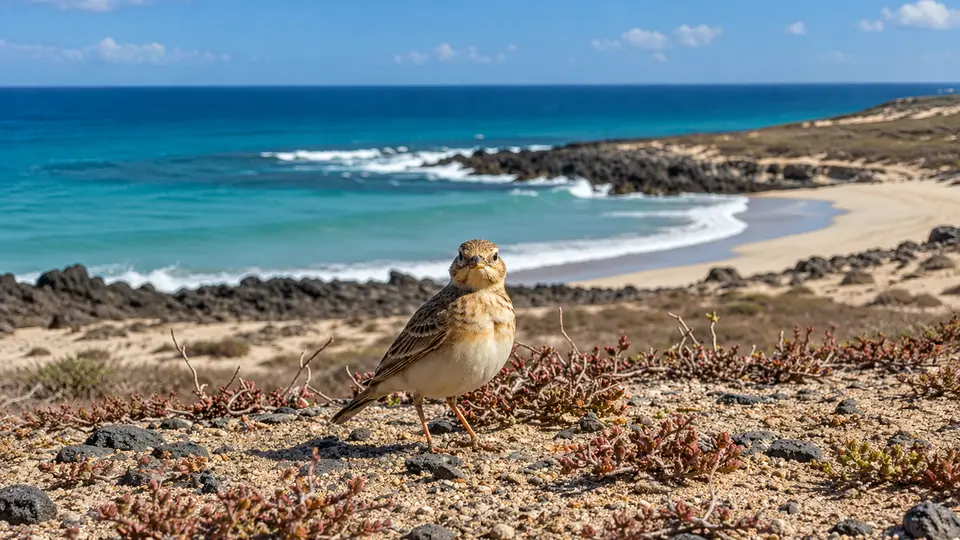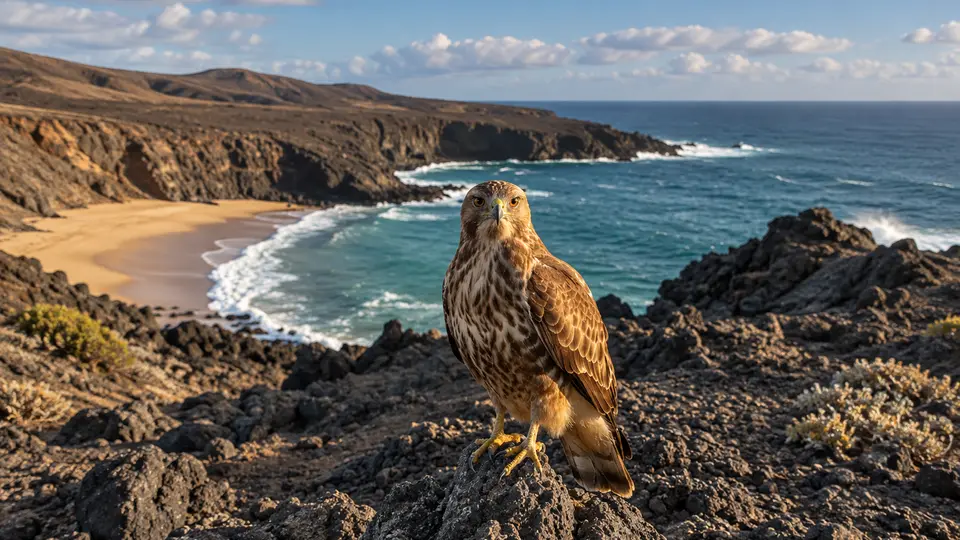
Cape Verde Buzzard in its natural habitat, AI illustration

Cape Verde BuzzardButeo bannermaniWhere and when to see them

Cape Verde Buzzard at a glance

The Cape Verde buzzard is an island-endemic raptor with a small, fragmented population. Formerly grouped with the common buzzard, it is now widely recognized as a separate species. Its broad wings suit soaring above steep volcanic terrain, where updrafts reduce the effort needed to search for food. It is not widespread across every island, and its restricted distribution makes habitat degradation, persecution and other local pressures disproportionately important to its future.

Behaviour & reproduction

Size
45-50 cm long
Weight
Not reliably established
Lifespan
Not reliably established
Status
Endangered

Buzzards search from elevated perches or circle on rising air, dropping toward prey detected on open ground. Individuals and pairs may repeatedly use the same slopes and valleys. During the breeding period, adults become more closely associated with nesting territories and can display above them. Cliff nests are vulnerable to disturbance from close approaches, while distant soaring birds may be difficult to identify confidently without sustained views of shape and plumage. Courtship displays, involving aerial maneuvers such as sky-dancing and undulating flights, can be observed during the breeding season. Pairs often maintain a relatively large home range, which they will defend against other raptors. Young birds typically fledge around May to July and remain dependent on parents for some time.

Top wildlife locations

Cape Verde wildlife habitat

Cape Verde

Rocky valleys and upland viewpoints on islands retaining buzzards offer plausible habitat. An inland excursion is usually required, and its restricted distribution means most ordinary coastal stops are unsuitable for a targeted search.
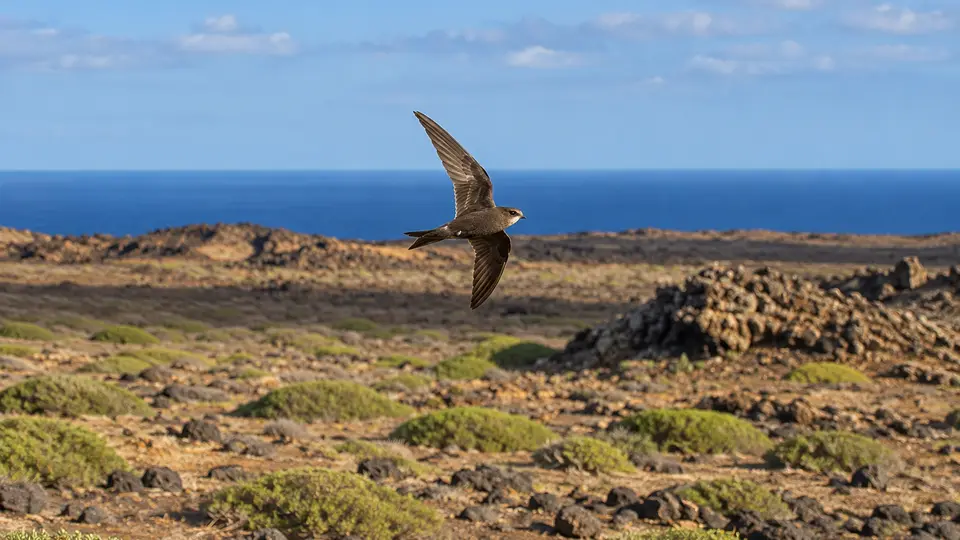
Destinations describe the species' habitat, not guaranteed cruise stops. Some animals require an optional inland excursion or are found in restricted reserves.

Fun facts about the Cape Verde Buzzard

  • It is endemic to the Cape Verde archipelago.
  • It was formerly treated as a subspecies of the common buzzard.
  • Volcanic slopes provide rising air that supports energy-saving soaring.
  • Its scientific name commemorates ornithologist David Armitage Bannerman.

Best time to see the Cape Verde Buzzard

This is a resident bird, with no migration-based visitor season. November to April generally offers comfortable conditions for inland viewpoints, although wind and cloud can obscure upland slopes. Breeding timing should not be inferred from this travel window, and nesting territories require particular restraint. The breeding season typically extends from February to June, with eggs usually laid between March and May. During this time, adults are particularly sensitive to disturbance near nesting sites. Outside of breeding, they are present year-round across their island habitats.

Cape Verde Buzzard: season matrix by destination

Travel and observation windows vary by region. Highlighted months are an orientation for planning, not confirmed sightings or a guarantee of access.

Cape Verde

A practical dry-season travel window for ridge watching, not evidence of seasonal arrival or a uniform breeding calendar.

JanFebMarAprMayJunJulAugSepOctNovDec
Cruise ships in Cape Verde

Where the Cape Verde Buzzard lives

Rugged volcanic uplands, rocky valleys and open agricultural mosaics provide hunting terrain. Cliffs and suitable trees can offer nesting or perching sites. Although some habitat lies near coasts, the most useful searches often involve inland slopes rather than flat beaches or busy waterfronts. This subspecies is endemic to the Cape Verde islands, with its range restricted to these specific Atlantic archipelago habitats. Although present on several islands, population density varies significantly depending on local topography and human disturbance. It often prefers higher altitudes and less developed areas.

What the Cape Verde Buzzard eats

Small vertebrates, especially rodents and reptiles, form much of the likely prey base, supplemented by other available animals and carrion. Detailed quantitative diet information is limited. Like related buzzards, it uses opportunistic hunting rather than depending on one narrowly defined prey species. Insects, such as large beetles and grasshoppers, are also consumed, particularly when small vertebrates are less abundant. Occasional reports suggest the taking of small birds, especially nestlings or fledglings. Carrion consumption can be more frequent during periods of food scarcity.

Species at a glance

Common name
Cape Verde Buzzard
Scientific name
Buteo bannermani
Animal group
Birds
Size
45-50 cm long
Weight
Not reliably established
Lifespan
Not reliably established
Status
Endangered
Identification
Its broad-winged, short-tailed buzzard shape separates it from local falcons and fork-tailed kites, although plumage alone does not reliably distinguish it from all visiting Buteo buzzards. The Cape Verde buzzard generally presents with darker plumage variants compared to some mainland European buzzards, often exhibiting a uniform dark brown back and prominent barring on the undersides of the flight feathers. Pay attention to the underwing pattern and tail banding which can aid in distinguishing it from other raptors, though individuals show considerable variation. Size and overall robust structure also help differentiate it from smaller raptors.

Cape Verde Buzzard: frequently asked questions

Where can I see the Cape Verde Buzzard?
Cape Verde. Scan ridges from established roads or viewpoints with binoculars. Do not approach occupied cliffs or use bait, and remain well back from steep edges while following a circling bird through the sky. On cruise excursions, focus efforts on higher elevations and the interior of islands like Santiago or Santo Antão, where suitable habitat is more extensive. Patience is key, as these raptors can be inconspicuous when perched motionless on a rock or tree. Look for thermals developing mid-morning as they begin to soar.
When is the best time to see the Cape Verde Buzzard?
This is a resident bird, with no migration-based visitor season. November to April generally offers comfortable conditions for inland viewpoints, although wind and cloud can obscure upland slopes. Breeding timing should not be inferred from this travel window, and nesting territories require particular restraint. The breeding season typically extends from February to June, with eggs usually laid between March and May. During this time, adults are particularly sensitive to disturbance near nesting sites. Outside of breeding, they are present year-round across their island habitats.
How big does the Cape Verde Buzzard get?
45-50 cm long. Adult weight: Not reliably established. Size varies with age, sex and population.
How should I behave around the Cape Verde Buzzard?
Scan ridges from established roads or viewpoints with binoculars. Do not approach occupied cliffs or use bait, and remain well back from steep edges while following a circling bird through the sky. On cruise excursions, focus efforts on higher elevations and the interior of islands like Santiago or Santo Antão, where suitable habitat is more extensive. Patience is key, as these raptors can be inconspicuous when perched motionless on a rock or tree. Look for thermals developing mid-morning as they begin to soar.
What does the Cape Verde Buzzard eat?
Small vertebrates, especially rodents and reptiles, form much of the likely prey base, supplemented by other available animals and carrion. Detailed quantitative diet information is limited. Like related buzzards, it uses opportunistic hunting rather than depending on one narrowly defined prey species. Insects, such as large beetles and grasshoppers, are also consumed, particularly when small vertebrates are less abundant. Occasional reports suggest the taking of small birds, especially nestlings or fledglings. Carrion consumption can be more frequent during periods of food scarcity.
Are wildlife sightings guaranteed on an adventure cruise?
No. Animals move freely and routes, weather, access restrictions and local conditions influence every outing. Confirm the actual itinerary and shore program before booking.

Compare wildlife in the same destinations

Explore other birds recorded in these destinations. Similar surroundings do not mean the animals share the same habits or viewing season.

Species comparison by animal group and destination
Cape Verde BuzzardCape Verde BuzzardAlexander's SwiftAlexander's SwiftBar-tailed LarkBar-tailed Lark
Animal groupBirdsAnimal groupBirdsAnimal groupBirds
DestinationsCape VerdeDestinationsCape VerdeDestinationsCape Verde
All wildlife destinations
Plan your trip

Find your next wildlife adventure

Compare destinations, shore programs and dates with the animals and habitats you would love to see.

  • Naturalist-led shore excursions
  • Responsible wildlife watching
  • Small expedition ships

Newsletter

Take Blue Rides with you

Adventure cruise offers, last-minute deals and trip inspiration.

Free, unsubscribe anytime. Details: Privacy Policy

Partner with Blue Rides

Affiliate Program

Recommend adventure cruises and earn commission on every confirmed booking.

Share. Track. Earn.

Your footage, our stage

Send us your videos or pictures.

Captured remarkable nature or wildlife on your journey? Share it with us, we may feature it on Blue Rides.